2012: not the end of the world

As 2011 draws to a close, we find it easier to imagine the world ending than to imagine a seismic change of the sort that seems likely in 2012. Apocalypse cults herald the Rapture and the Mayan prophecies of doom, but critics of capitalism stop short of imagining a revolution in America or a new political order in the UK.

The stories we tell about the future are no longer hopeful, excited tales of technology and human spirit revealing new vistas of experience and exploration. Toby Barnes talked about this in his excellent post wrapping up Playful 2011: “Our visions now seem to be so close to home.” Not just in science fiction, in the stories we write and the movies we see, but in other areas of culture too, we go around in circles exploring the past. The New Boring aesthetic is everywhere, in our television, our clothes, our music, our interior decoration. Even cupcakes and cake stands are back.

It’s a little like the UK has collectively mislaid the cultural ability to imagine beyond the horizon, and started looking backwards over its shoulder instead. Not lost, because that implies it won’t come back, when the world stops changing so fast and people have jobs and can afford to eat and pay bills comfortably again (assuming that happens). But we have shifted our focus away from the shiny bright realm of limitless possibility to the scary possibilities of the present. While in some parts of the world 2011 has been about imagining revolution and embracing hope, in others the realm of the future has become a place where ends are easier to envisage than evolutions.

The same is true of the news industry. In a year when a British newspaper was unceremoniously killed by its owners, the end of a national newspaper suddenly changed from something hard to picture into something easy to recall. It’s much easier to envisage the end of the newsprint business than to conceive of its evolution. It’s harder to imagine what the news business in general will look like in 2031 than it is to imagine that there simply won’t be one. The apocalypse is a much easier story than the sci-fi future, these days.

I hope, in 2012, that changes. I hope we get our hopeful visions back.
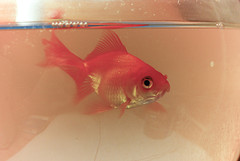
What the water feels like to the fishes

Goldfish Depression sneaks up on me around this time of year. Most years I spend these late months down, though some more so than others. There’s something about the slow dying of the light that brings out the noonday demon, bleaching colour from the day and bringing sharp edges to the night.

Though that’s too poetic, really, for the drab reality. Sleepless nights followed by nights of too much sleep, leaving me drained and exhausted regardless. Headaches that don’t leave, restlessness without cause, and sadness that turns up unexpectedly mid-sentence and refuses to dissipate. Most of all, a thin veil that descends between me and the world, dulling joy and blunting emotions, making it hard to participate through the feeling of awful apart-ness, as though I’m watching life on a screen and not participating. In the summer I take on dozens of projects, safe in the boundless energy the light brings. In winter, I count spoons and mete out activity in careful, measured portions, for fear of failing to cope. Without Grant, I would struggle to eat well or sleep at all.

For some people – I’m one of them – depression is just a fact of life. I don’t remember a time before depression. I guess I was 11 when I had my first full-blown episode; I know I was 12 when I was first diagnosed. I know what it’s like to be happy, but I don’t know what it’s like not to have to hoard it, guard it, trace its contours for as long as I possess it. To not know with certainty that it is fleeting, and must pass.

That is one of the cruellest things about this illness. It perpetuates itself in the knowledge of itself. Depression is itself depressing. And terribly boring, too. So many depressives – myself included – develop other problems in part to cope with the bleakness of the dark mornings, but also because they are at least something that can be controlled, and that brings an upside, a dramatic, vivid illustration of the pain we’re in, and something else to focus on. Perhaps it’s taboo to suggest that anorexia, alcoholism, self-injury and so forth have benefits, but it’s true; otherwise, they wouldn’t be so seductive. I recall vividly a psychiatrist telling me that if they could bottle and prescribe the psychological effects of self-harm without the messy reality, it would be the most effective antidepressant ever – and one of the most addictive.

So in the down times I cope not only with the depression itself but also with the desperate animal-in-trap desire to hurt myself, something counterproductive, self-destructive but also self-preservative, something that – if I could control it and mitigate its down sides – would be the best possible way of dealing with the depression. That, I think, makes it harder – to know, intimately, that there is an easy option, and still not to take it.

But then, this too shall pass. The most powerful knowledge I have is that this will pass. It must pass. The blackness is not permanent; the sun will rise again. What I fear most is forgetting that such sadness is temporary. That way lies madness.

This post was imported from my Tumblr as part of a big reorganisation of my online self in January 2012.

What do we do instead of reading the paper?

For news organisations, especially ones rooted in print, stories have totally changed since the advent of the internet. I don’t just mean our stories, I mean the ones our readers put together internally without noticing it, about what they do and see, constructing the assorted stuff and fluff of the day into a nice neat narrative which contains a sensible answer to the question: What did you do today?

It used to be that “reading the paper” was a single activity, physically and mentally, bounded by the single physical experience of picking up a newspaper and then, well, reading it. Not all of it, probably. Not even necessarily very much of it. Not everyone starts in the same place or cares about the same articles. But even if you read completely different bits of completely different newspapers to everyone else in your office, or even if you just looked at page 3 and the punny headlines and then called it a day, you still called it “reading the paper”. And that’s how it turns up in the story of your day. (What have you done at work so far? Not much, just read the paper and answered some calls.)

It also used to be bounded by the covers of the paper, not by the subjects you pick within it. Which paper do you read? Your identity is to some extent bound up in that brand choice, in the UK at least – people have made good satire about this, and there’s a wider point. Your newspaper said something about you. It featured in the story you told yourself about yourself, as well as the one you told other people. Reading the paper isn’t just learning about the news or the sport or the arts coverage; it’s also an element of your identity, a piece of your personal puzzle. A Guardian reader is not the same thing as a Daily Mail reader. Most people only get one.

Except that’s all gone out the window, now. The Mail Online has god-knows-how-many million readers; the Guardian has a smaller but still reasonably mind-bending number. Both numbers are too big to imagine and you have to resort to comparisons like the population of London. And of course those audiences overlap. They’re both much bigger online than in print, and they both require much smaller commitments in terms of reading – a single article, not a whole paper (whatever a whole paper used to mean, anyway). But also, and this is important, because reading one or two or twenty articles from a single news source doesn’t make me a “reader” in the way that it would if I “read” the paper. Not in the story I tell myself about myself, and not in the story I tell other people.

Which wouldn’t be so hard to manage, if it wasn’t for the first problem. Because actually it’s really easy to miss that you read an article from a newspaper, if what you’re doing is browsing the net or chatting on Facebook or catching up on Twitter. You click a link from the thing you’re doing, you read the link, you click “back”, you carry on. You can do that dozens of times, clicking all over the place, and still it doesn’t turn up in your story of the day as “reading the news”. What are you doing? Just checking Facebook. Or wherever.

Apps take you back to that activity of reading the paper, reading the news, within the nice neat cozy boundaries of a virtual cover even if not a real one. They require certain physical activity, too. It took a while for that to click with me, but I think I get now why print people are comfortable in app space.

But people that actually go to the front pages of news sites online are pretty few and far between, compared to the numbers that just turn up on article pages when they’re in the middle of doing other stuff. So obviously that raises huge issues about making sure that every article page is a good front page, a good gateway into your site, good enough to maybe persuade a couple of those people not to click “back” but to stick around and change what they’re doing. But also it raises issues about the visibility of what news organisations are doing. Because if your readers don’t consciously realise they’re your readers, that has to change the way your brand works.

#jcarn: Dear Santa, please bring us all more time

Given the recent dearth of posts on here, my request in response to this month’s Carnival of Journalism prompt is probably not surprising, though it may be impossible.

Dear Santa, for journo-Christmas I would like more time. Not just for me, but for everyone.

I was lucky enough, recently, to be part of a Guardian hack day. As a result, some awesome tools got built, including three that I started using inmediately. They’re still very much in beta, being improved and worked on occasionally, but I use them constantly. They’ve changed my job. Not by giving me new things to do, but by automating some repetitive, tricky, admin bits of the job and therefore making them require less time and attention – so I can spend more time and energy focussing on the bits that really need it.

That’s wonderful. It’s a gift of time. It means I can work smarter, not just harder. I wish, if I have to be limited to one Christmas wish, that every journalist and everyone involved in making journalism – including developers – could have at least one tool, in 2012, that makes the tedious admin bits of their jobs faster. I hope that every tricky CMS for journalists that contains unnecessary time-consuming admin processes releases an update that makes it no longer so.

And, because this isn’t a one-way process, I hope that every journalist takes the initiative to go find out where their techies live and actually talks to them, in person, about the problems they have. There’s no point griping only to each other about the difficult bits, or in keeping quiet and carrying on doing things that don’t make sense: tell developers what’s wrong, because otherwise they won’t know it needs fixing. Sometimes what looks like a tech problem is actually a communication issue, because the people who need to know that something’s broken haven’t been told.

These fixes often aren’t the big, sexy, exciting projects for devs. They’re the sort of thing that, if it exists, you very quickly take for granted. Things like, say, a spellchecker that also flags up common house style violations, or a geolocation module that understands when you type “Norwich” that you want the geographical area defined by the boundaries of the city of Norwich, not a point at the centre of its postcode area. They’re often small niggles that you’d only notice if you’re doing these processes day in, day out, many times a day.

In an age of cutting costs, one of the most precious resources we have left is our time. Anything that saves it, that means it can be spent doing journalism or making tools that journalists can use, instead of busywork, is a wonderful thing.

Oh, and if you work in a place that has admin staff, go say thank you to them. They deserve it.