Exploring the read/write world

Yesterday, Nick Booth at Podnosh posted a transcript of a conversation on Twitter where he asked for useful analogies to describe the internet to people who’ve only experienced radio and tv.

The conversation – and the comments – got me thinking about the way metaphors limit what we can understand about the online world and affect how we use it, particularly the page/document conceptual metaphor that pervades our language.

We use print language constantly online. Web pages, archives, scroll, above the fold, inbox, email, post. The metaphor is pervasive and often goes unnoticed as we use the language that reinforces it, making it hard to tease out the implications and assumptions of this mindset.

But pages aren’t flat, static, words on the screen as we see in print papers. What happens if we call a page a node? Or a window? Or a stream, a fall, a flow, a conversation, a connection, a junction?

Conceiving of pages as stories, for instance, opens up the idea of letting journalists develop an entire story online, rather than in our notebooks. Posting complete transcripts of interviews, not just the quotes we think are important. Including raw footage alongside the edit for those who are interested. Asking at early stages of a project where users think we should be investigating more. Incorporating links to our research and visualisations of our data not when we think they are relevant but when we stumble across them.

Conceiving of pages as junctions makes flat print-like design stand out as inadequate – not fit for their intended purpose, which is to facilitate forward movement and choice for reader.

And what if, instead of a reader, we have a traveller? The idea of a reader implies commitment, passivity, and above all a text-based medium. A traveller is someone who can leave at any moment, and opens up the idea of the page as a literal place – a location that can be moved through and explored rather than a document.

Thinking of the web as a series of pages gets us print design replicated online, lacking the myriad subtleties that are possible in a space that is simultaneously a limitless sea of connections and a location and a conversation and a lot of other things. Essentially, it gets you the front page of the new Times website – pretty and clean, but flat and without the cues many travellers use to make meaningful journeys through the web.

Thinking of it in any other way at all requires seriously examining the words we use, and playing with putting others in their place. Each conceptual metaphor has its own problems – calling the internet a brain inadvertently implies the organised hivemind that Twitter users protest does not exist, for instance – but we need a library (or bathtub, or pantry) that’s full of different options in order to open up new ways of thinking about what’s possible online.
JEEcamp thoughts on data journalism

I spent some time talking to Martin Belam (@currybet) about data journalism and the importance (or otherwise) of journalists learning to code.

He said, as he’s said before, that it’s more important for journalists to know whether something is or isn’t possible than for us to necessarily be able to do it ourselves.

And for working journalists whose day to day job doesn’t carry a coding requirement already – and particularly those of us who are lucky enough to be in a workplace where there are developers or programmers who can take our ideas and make them flesh (ie. not me), he’s almost certainly right.

Those skills are becoming more and more important. With the birth of data.gov.uk and the increasingly open approach to information that the new coalition government is likely to take, sifting and analysing data to find the stories is going to be a vital skill for a lot of journalists.

We need to know our way around a spreadsheet. We need to be able to spot patterns in data and understand not only what they mean but also how we can use them to reveal stories that are not only relevant but useful.

We need to know where our skills can get us. We need to know our capabilities and our limits – and, crucially, we must be aware of what we don’t know. That’s not just knowing that there are holes in our knowledge, but knowing the shape of those holes so that we can try to get our problems a little closer to a solution.

Journalism is about asking the right questions. We research stories before we interview subjects so that we can ask pertinent questions whose answers will illuminate the subject. We need to be able to do the same thing with our data – we need to know what questions to ask and how, so that even if we can’t make the tools ourselves we can hand over the task to someone else without asking the impossible or wasting their time.

But most of the time, certainly for journalists on regional papers and I would wager for many in other areas, those people who know how to make the tools just don’t exist. I have friends who code, but I can’t ask them for a favour every time I want to create a news app, or diff two versions of a stack of documents, or visualise a complex dataset, or tell the story of 100 people’s losses from an investment fund going bust in a way that conveys both the scale and the humanity of the problem.

Regional journalists work on hundreds of stories that could be made vastly easier or more beautiful or more accessible through a touch of computer work (spreadsheets, maps, things that aren’t quite coding but sort of almost are and look like it to the untrained eye). A few of us can create those additions; the rest just write the story, and our papers and websites are poorer for it.

We work on a few stories – and the number is increasing – that are perfect for news apps, web coding, multimedia packages or other more complex solutions that very, very few of us can create. But no one else will do it for us.

On top of that many of us struggle with inflexible content management systems that penalise or make it literally impossible to display data-driven work online. Faced with that problem, some budding computer-assisted-reporters give up before they’ve even started.

So I’m not going to stop learning Python. It’s not a complete solution to the problem – for that we need real, systemic change so that the businesses we work for all value data work, understand its increasing relevance, reflect on current practice and support training journalists to do an evolving job.

But for me, it means that in the future I might be able to create better stories, automate processes within series or campaigns or multiple follow-up stories, make my job easier and make a better experience for the reader all at the same time.

At least, until we all have newsroom developers.

Playing in the streets

Download now or preview on posterous

HSHletter9.pdf (1283 KB)

There’s a cake shop next door, a giant hamster over the road and soldiers are fighting zombies on the roof. MARY HAMILTON welcomes you to the new-look Evening News.

Breaking news: the postman has delivered a letter.

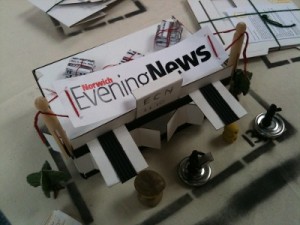
That’s how most of the news comes in to the Home Sweet Home offices of the Evening News. It’s delivered by a tall man in short trousers, a flat cap and socks, who leaves the envelopes leaning up against the front canopy of the 20cm cardboard building.

I built the office myself, from flat-pack cutout to fully-fledged busy office building complete with newspaper bundles and Plasticene journalists, sharing glue, card and colouring pens with neighbours and strangers.

I even recreated Bernard Meadows’ eyecatching bronze ball sculptures, carefully rolling and squeezing yellow moulding clay and poking it gingerly with a pencil, before giving the rest of my clay to an excited six-year-old who wanted to make bees for her garden.

It is part of a performance – or perhaps an exhibition – called Home Sweet Home, the brainchild of Goldsmiths graduates Abigail Conway and Lucy Hayhoe, in which participants build their own city from flat-pack parts and then experience its evolution as it fills with people playing along.

Watching the tiny town sprout from a black and white canvas into a riot of colour in the extravagant surroundings of Blackfriars Hall was both surreal and sublime, as bizarre buildings and peculiar personalities developed thanks to the imagination of neighbours.

But when the letters began to arrive the town took on a new and magical dimension, with stories, greetings, and feats of collective imagination all emerging thanks to the postal service and the presenters at the radio station.

My letter reads: “Dear Editor, An escaped swan ate my shoes!  Please put it in your newspaper! Yours, Joz Norris, No. 188”.

Immediately I spring into action. I post a breaking news update on the billboard outside the office – crafted from matchsticks, card and successive layers of paper posters – and dash off a return letter asking for more detail about the attack.

Over time, petitions spring up on the community notice board. A campaign to build a public swimming pool gathers pace. Disgruntled residents try to force an election. A little girl who runs a flower shop donates a sponge-and-cocktail-stick floral display to my office.

A small zombie outbreak spreads and threatens other city properties, so the Evening News drafts in a local militia to fight them off. Other businesses welcome the zombies, selling them vintage clothes and inviting them in to a night club.

And I get another letter from Joz saying that he’s bought another pair of Doc Martens but he doesn’t think he’ll be able to look a swan in the eye ever again.

The whole experience is a testament to the power of play. Adults and children alike tap into the storytelling possibilities of the town, expressing their personalities through their houses and opening them up as the community evolves around them.

While some people come along, build houses and leave, those who stay build stories around their houses, and the whole community evolves and changes as the project progresses.

A giant hamster in the back garden of one house is asked to join the Spiegeltent as a performer. A few hours later he has moved to the circus with signs advertising his upcoming performances.

I spend the weekend doing what journalists do: asking questions, writing down stories, monitoring the notice board and answering letters, preparing for a burst of activity on Sunday night as I put the Home Sweet Home edition of the Evening News together.

The following day, when I return to Blackfriars Hall with a stack of miniature newspapers under my arm, the Spiegeltent has disappeared, replaced by a giant hamster run with tunnels, hoops and a swimming pool.

I arrive at the office to discover someone has stuck a giant red ball to my door, in imitation of the large inflatable ball currently touring Norwich as part of the Norfolk and Norwich Festival. They are planted on the church, the fire station and the city hall, too.

For a short time this miniature cardboard community has been incredibly real. It has had action, politics, feuds, joy, fear and anger, and the people who created it have told hundreds of tiny stories that were, for a while, incredibly important, as they literally changed the way their city was constructed.

As the houses were dismantled and returned to their owners, I felt deeply privileged to have been present at the birth and the death of Norwich’s smallest suburb, and to have been able to tell just a few of the stories the residents created.

A version of this article and its accompanying miniature newspaper
were originally published in the Evening News
(www.eveningnews24.co.uk).

Posted via email from InterMediaMary