We are in a buyer’s market for news – and for journalists too

International Money Pile in Cash and CoinsFor this month’s Carnival of Journalism, Michael Rosenblum asks: “Is it possible for a good journalist to be a good capitalist?” My answer: yes, but the people who employ journalists tend to be a lot better at it than the journalists themselves, thanks to the state of the market and the laws of supply and demand.

Entrepreneurialism – while it can be brilliant and is a vital part of the ecosystem – is risky, difficult, sometimes soul-destroying, and the odds are against you ever making more money from it than you could from more traditional employment. Freelancing is, of course, not the same thing as being an entrepreneur, and while plenty of journalists go down that route the money is often scarce and the financial position insecure. At present journalism jobs – outside specialist markets like financial journalism – are few and far between, and even at their best the money pales in comparison to some other professions, as Michael points out in his introduction post.

Many journalists don’t want to be – aren’t cut out to be – technical or technological innovators, or freelancers chasing clients for cash. Some of us love digital production and want nothing more than to be playing with new ways to tell stories. Others want nothing but to be allowed to get on with their important investigatons, or their war films, or their pithy columns. I am unequivocably in favour of journalists learning new skills in order to do their jobs more efficiently and more effectively – but when it comes to demanding they move away from their specialism and into areas they may not enjoy or be good at, I get a little uncomfortable. Not everyone can or should be a jack of all trades.

This is a supply and demand problem. This isn’t an issue of journalists not wanting to make money – it’s an issue of there being an awful lot of very talented journalists, from new graduates to grizzled veterans, all of whom would like to be able to eat. Journalism right now is a buyer’s market, and content is very cheap. The people at the bottom of the rung who can afford to work for free will do so; freelancers who can undercut the competition will get the gig. Employers who want to employ journalists and cut costs at the same time can pay so little, because so very, very many people want a job in journalism, have sunk years of time and a great deal of money into the prospect of a job in journalism, and are willing to work for little cash because of their principles and desires.

Much like news online, journalists’ skills are devalued not because they are not respected, but because they are abundant. Much like an absolute paywall, unless you have unique content or the ability to ensure everyone adheres to the same pricing strategy, charging more for your work is likely to simply make people turn elsewhere. The macro issues affecting the industry hit journalists individually too. The solutions to both problems remain unclear.


A simple point and click interface: zombies at London IA

Demons at ZombieYesterday I gave a short talk at London IA, about one of my side projects: zombies, LARP, morris dancers, demons, creativity, delight, verbs, NERF guns and (ostensibly at least) user experience design. Slides – expertly drawn by @gshowitt – are here, and my notes are below the fold.

Continue reading A simple point and click interface: zombies at London IA

Adaptation is continuous. It isn’t going to stop

EvolutionWe live in the future. The pace of change is astonishingly fast, and it’s accelerating. We’re living through not one but at least two huge technological advances – hardware in the form of computers and mobiles and tablets, and the network itself. We’re just starting to see the social changes that come as a result of those things: interlinked networks, technologically enabled, doing new stuff like Wikipedia and Wookiepedia and breaking the entire news industry by publishing stuff immediately and talking to each other directly.

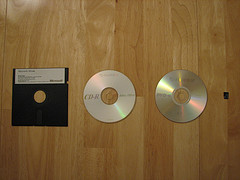
Of course, children born today have no idea what a rotary telephone is, or a vinyl record. That’s not a hard thing to understand. What’s startling is realising that most 12-year-olds now have no idea what the save icon in Microsoft Word is meant to look like. Floppy disks are gone. We’ve gone through so much tech so fast.

But we’re not done with those changes. Not even the network changes are over, never mind the hardware and the social effects from those things. We have got so many more years of this to come – magical devices emerging from big conferences that change the way your whole life works; new ways of having conversations and sharing things and spreading information virally that come out of tiny startups with no cash. Things we can’t imagine yet, but that will seem inevitable as soon as they exist.

We don’t get to stop yet. In fact, we probably aren’t going to stop in my lifetime. I’ve made my peace with the idea that every solution I work on, every innovation I’m part of and every exciting development I eagerly enjoy is a step on the way somewhere else. Everything we are currently doing is temporary.

It’s pointless trying to adapt to survive the current conditions and then stopping. By the time you’ve adapted the current conditions will be old news. In three years’ time your nice, completed adaptation will be obsolete.

That doesn’t mean we get to stop doing it. It means that – in the news business especially – we need to get a move on doing it now. We need buckets of innovation now, in chunks that we can test and deploy and iterate on and learn from, so that in six months’ time we can be doing the next thing. And then the thing after that. And then the next thing. Because standing still would be monumentally, suicidally stupid.

This post was brought to you by @currybet on innovation, @adders on disruption, and @yelvington on Kodak.

3 ideas about the future of print news

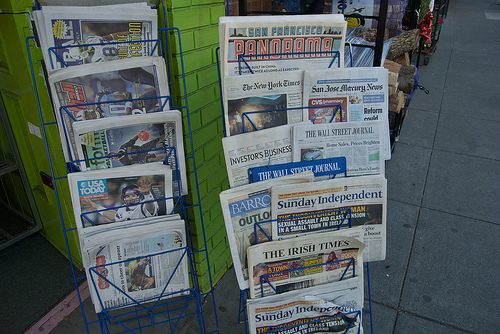
McSweeney's San Francisco Panorama amid New York Times & other newspapers at West Portal Daily
Spot the odd one out.

A friend recently emailed me to ask about what print newspapers would look like in the future, for a sci-fi story he’s writing. His words:

“Obviously the It’s The Future! thing to do would be to say they only existed digitally, but I’m reluctant to go right down the route in case it’s a bit too holo-TV and flying cars, so knowing where you’d put your money on this particular bet would be very handy.”

It made me consider the question in a way I hadn’t before – and here’s the response: three sci-fi-ish narratively-useful ideas grounded in reality, about what print news could look like in the World Of Tomorrow.

1. Print-your-own

Berg has just announced a mini in-your-house printer magic box cloud news thing. This is actual wizardry. The evolution of devices like that is basically a personal printed news sheet that you grab on the way out of the door, read on the commute and recycle at the office. Or that greets you with the day’s news in print when you arrive home, or gives you a non-screen thing to read with breakfast so it doesn’t matter if you spray ketchup on it. And it weaves personal/social news stuff in with “proper” news sources. It’s unbundled in a very cool way.

2. Artefact

The newspaper that carries your birth date, or announces your marriage – the one you appear in – is a thing people still want to keep. There will be more cut-out-and-keep, more souvenir editions, and quality of production will go up along with prices, until each paper is a beautiful object in its own right. Something along the lines of some of the really innovative papers at the moment – the prettier ones here are starting to move in that direction – or McSweeney’s San Francisco Panorama.

At its most extreme, this could end up with weekly papers being more like glossy magazines – something to sit on your coffee table for days at a time, something you can dip in and out of during the week, carrying good long reads and beautiful pictures – the sorts of lean-back things you can really do well in print.

This might be the least likely of the three to come in, because even though the infrastructure is already there, the folks in charge of newspapers want to stay mass-market as long as possible so won’t make the design investments to switch to niche. And it’s questionable whether the business model would actually pan out, given distribution costs.

3. Free

People will still read something if it’s handed to them when they’ve nothing else to do. Metro and Evening Standard will still do well, in London at least, as long as there are captive commuters – though when wifi is installed on the Tube that’ll be very disruptive to their businesses and they’ll have to up their game to compete. Free sheets, supported by ads, won’t go away until/unless the last of the display ad business dies.

If free papers can come up with a better way of tracking who actually reads them and what they do, and sell that model to advertisers, then free sheets could end up being the most profitable of any medium. So depending on how near, innovative and prosperous the near-future is, it might be worth thinking about offline tracking in your newspapers – RFID trackers that would let companies see how far their papers travel and how many times they’re read, or giveaway cards that would unlock something extra (rewards online, possibly, or free coffee/pasty/Twix offers) in return for a name/date of birth/postcode.

What else?

What did I miss? I didn’t say local, because I don’t think many local papers will exist in 30 years’ time in forms other than those above. That’s not to say local news won’t – in fact, it’s likely to be much stronger than it is now, thanks to better local networks, horizontal vectors for information to spread, facilitated by but not limited to the internet. Will any news organisations run print papers as loss leaders, for prestige or for other purposes? Or will there be any profitable newspapers that aren’t also artefacts?